Building & shed pads
Cutting, filling and compacting a level pad for a shed, garage, granny flat or house. Usually followed by our own slab — see shed slabs.
Excavation & site preparation
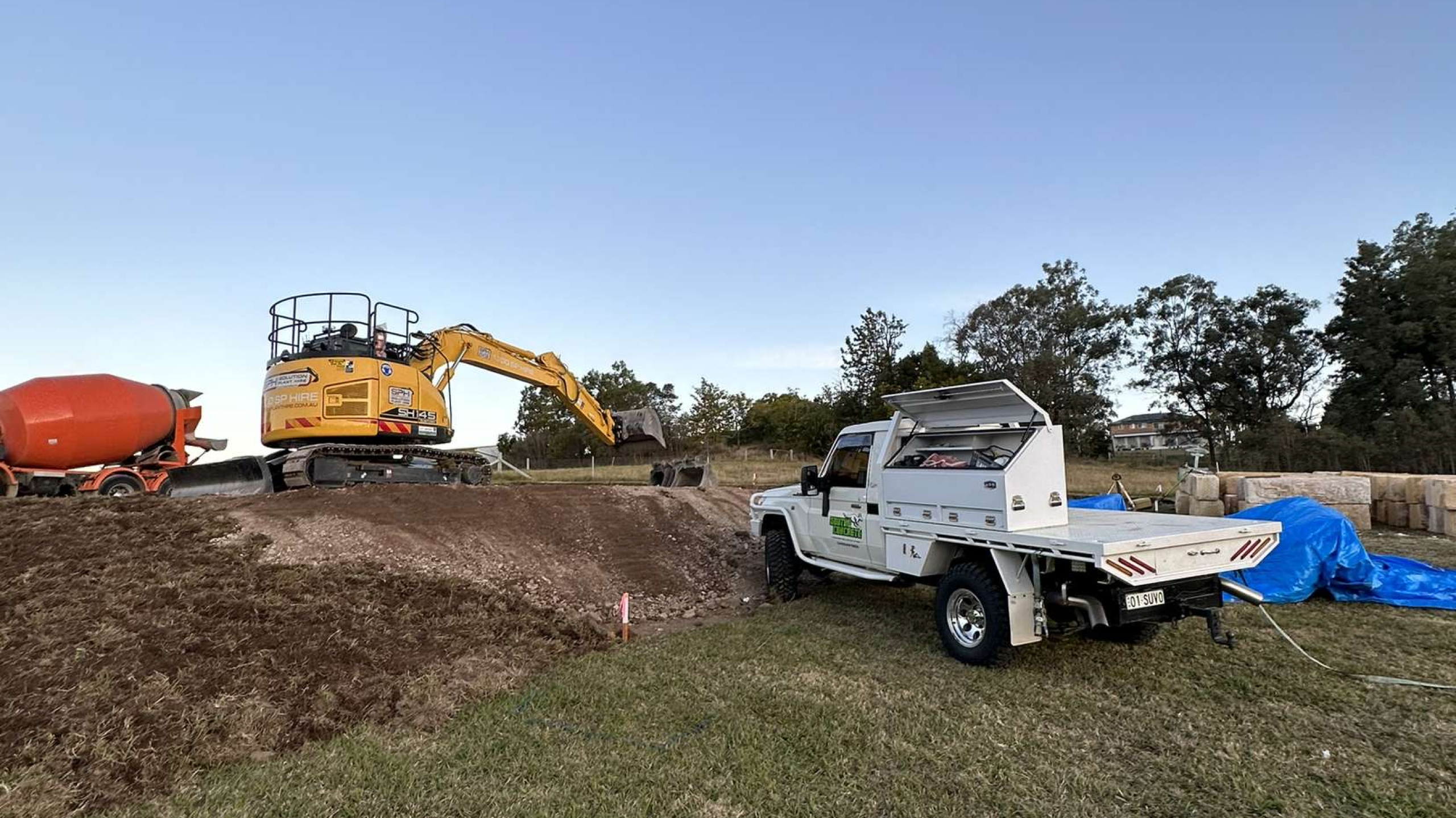
Plenty of concreters walk away from a site that isn’t already flat. We do the earthworks ourselves — cut, fill, level and drainage — so you get one crew, one quote and no gap before the pour.

Almost always, and how much is the biggest unknown in any concrete quote. Ground has to be cut to level, soft spots and tree roots removed, fill compacted in layers and water given somewhere to go. Skip it and the slab above cracks or settles — not immediately, but within a few years.
The complete package
This is the stage most concreters quote around. We do it in-house, which is why we can take on sites that get knocked back elsewhere — and why the concrete we pour sits on ground that was built for it.
We walk the block, check fall and drainage, find where water currently goes, and identify rock, fill, services and trees before anything starts.
Vegetation, stumps, old slabs, fencing and rubbish removed. On acreage this often includes opening up a work area that has not been touched in years.
The pad cut to level, with spoil either balanced on site or carted away. Cutting into firm ground rather than building up on soft ground wherever the levels allow.
Fill placed and mechanically compacted in layers, not dumped and levelled. Uncompacted fill is the single most common cause of settled slabs and cracked driveways.
Ag lines, cut-off drains, surface falls and stormwater connections so water leaves the site instead of sitting under whatever gets built on it.
Temporary tracks and turning areas so trucks, pumps and trades can actually reach the work. On long rural blocks this is a job in itself.
Types
Most of this work leads into concrete we then pour ourselves. Some of it stands alone.
Cutting, filling and compacting a level pad for a shed, garage, granny flat or house. Usually followed by our own slab — see shed slabs.

Stripping, boxing out and preparing the base for a new driveway, including long acreage driveways with fall and drainage to manage.

Clearing scrub, stumps, old structures and accumulated material to open up usable ground on rural and acreage properties.
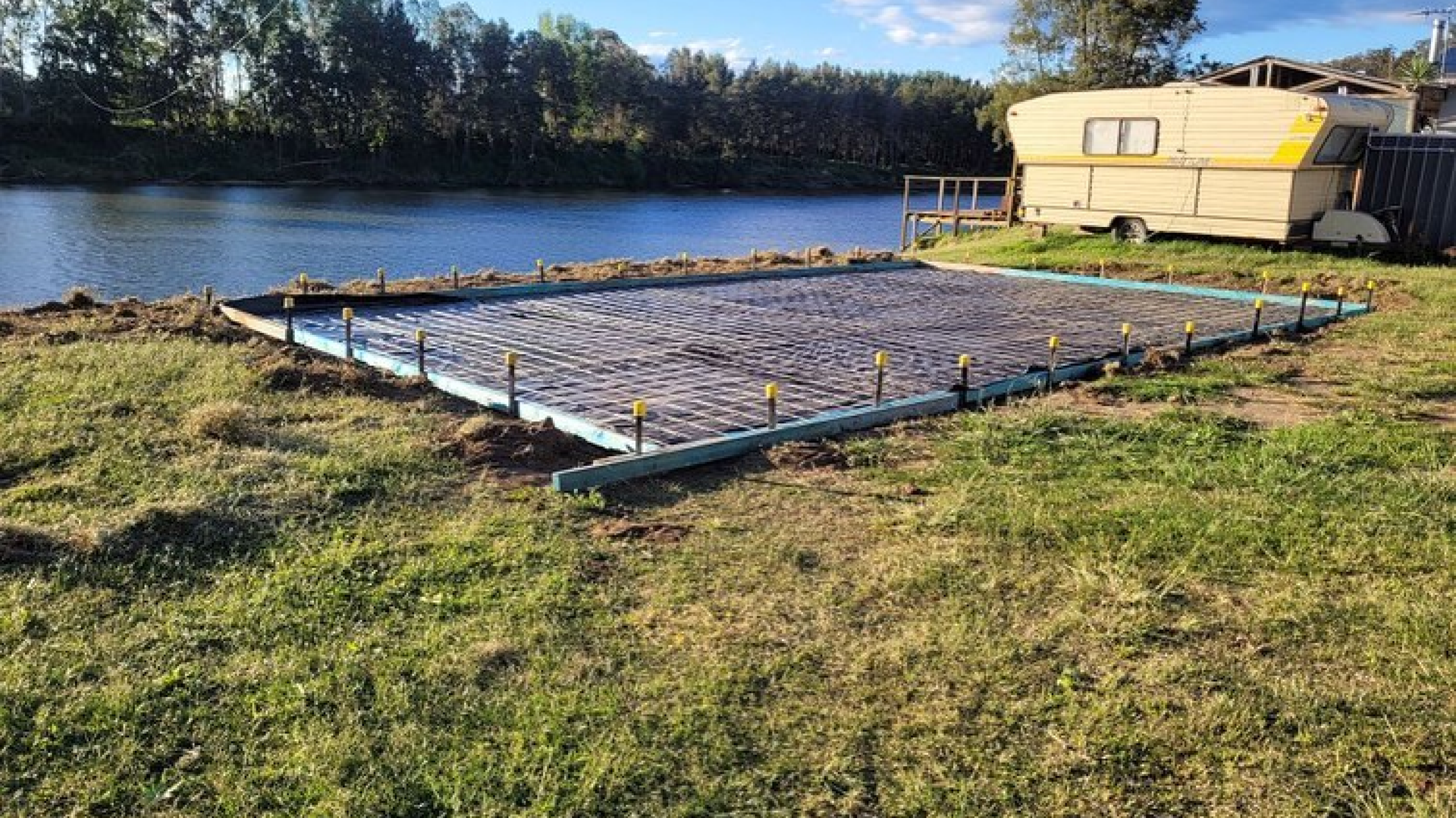
Benching a level platform into a hill, usually paired with a retaining wall — see sandstone retaining walls.

Ag lines, cut-off drains, stormwater runs and service trenches. Often the cheapest fix for a problem that looks structural.

Temporary or permanent tracks and hardstand so machinery and concrete trucks can reach a work area that is otherwise unreachable.
The difference
Plenty of concreters will pour on whatever base you give them. The problem with that arrangement only shows up later, and by then there are two contractors pointing at each other.
When the same crew cuts the pad and pours the slab, there is no argument about whose fault a settlement crack is. We own the whole sequence.
Because we do the digging, we price the ground realistically instead of adding a contingency for someone else’s unknowns.
Difficult access, steep fall, long driveways, no hardstand. These are the jobs that get knocked back — and they are most of our rural work.
Compaction in layers takes longer than pushing dirt flat. It is the step that decides whether the concrete above is still sound in ten years.
Drainage goes in before the concrete, not after a problem appears. Retrofitting drainage under a finished slab is expensive and ugly.
No waiting on an earthworks contractor’s schedule before the concrete crew can start. The job runs continuously.
Pricing
Earthworks is the hardest part of a concrete job to price from a photo, because most of the variables are underground. These are the ones that move the number.
Before you dig
Three things worth knowing before any machine turns up on a property in this region.
Before any excavation, the location of underground electricity, gas, water, sewer and telecommunications assets should be obtained through the national Before You Dig Australia referral service, which is free and provides plans from participating asset owners.
Plans show approximate locations only. Hand-digging or non-destructive methods to expose services before machine excavation is standard practice, and SafeWork NSW treats contact with underground assets as a serious excavation hazard.
We lodge enquiries and locate services as part of our process. If you are engaging anyone who does not, that is worth asking about.
Sources: Before You Dig Australia (byda.com.au); SafeWork NSW excavation work guidance. Checked 15 September 2026.
Earthworks are not automatically unrestricted just because they are on your own land. The NSW Codes SEPP sets standards for cut and fill carried out as exempt development, including maximum depths, minimum distances from boundaries, easements and mains, and a requirement that the work must not redirect surface or ground water or transport sediment onto an adjoining property.
Support for earthworks more than 600mm above or below existing ground level must be an engineer-certified retaining wall or structural support.
Flood control lots, heritage items and environmentally sensitive land sit outside the exempt pathway altogether. Given how much of the Hawkesbury is flood-affected, this is worth checking early.
Source: NSW State Environmental Planning Policy (Exempt and Complying Development Codes) 2008 — earthworks, retaining walls and structural support provisions. Checked 15 September 2026.
Recent work



Why Southo
Not subcontracted. The crew that digs your pad is the crew that pours on it.
Steep, remote, no access, no hardstand. The jobs that make other quotes disappear.
The slow way, because it is the only way that stops the concrete above from moving.
Water is dealt with at the excavation stage, when it is cheap to fix.
If there is a real chance of rock or bad fill, we say so at the quote rather than discovering it as a variation.
Licensed NSW concreting contractor with public liability and home warranty insurance. Details supplied on request.
Tell us what you’re planning to build and we’ll tell you what the site needs before it can happen.
Reviews
Service area
Based in the Hawkesbury, working across the Hills, Sydney and the Central Coast.
Questions
Yes. Plenty of our earthworks is standalone — clearing, pads, drainage, tracks. That said, most people who call us want the whole sequence, which is where we are most useful.
Where the levels allow, we balance cut and fill on site, which is cheaper and faster. Where we cannot, it gets carted away. We tell you which one applies at the quote.
We assess the likelihood at the quote and tell you honestly. If rock is a real possibility we explain what changes, rather than pricing it low and raising a variation later.
Usually, and this is one of the things we are known for. Long driveways, soft ground, narrow gates and steep approaches are normal for acreage work. If we need to form a temporary track, we will.
Sometimes. The NSW Codes SEPP sets limits on cut and fill as exempt development, and flood, heritage and environmentally sensitive land sit outside it. Confirm with your council or a certifier before you commit.
Drainage goes in during excavation — ag lines, cut-off drains and surface falls that take water off the site rather than leaving it under the slab. Retrofitting this later is far more expensive.
Where it is part of a genuine project, yes. What we do not take on is small patch-up and handyman work, because it is not where we can control the result.

Accuracy note
Planning and engineering information on this page is general and was correct at the date checked against the sources named above. Rules change and every site is different — confirm your own situation with Hawkesbury City Council, The Hills Shire Council or a registered certifier. Spotted something out of date? Email southoconcrete2@outlook.com.