

Alfresco & patio slabs
The covered or partly covered area off the back of the house. Usually the highest-finish concrete on a property because it is seen up close, every day, in good light.
Outdoor entertaining areas
An outdoor area gets used when it’s the right size, sits at the right level and drains properly. We work that out with you, prepare the ground and pour a surface that feels like part of the house.

A properly prepared concrete slab, whatever goes on top. Pavers, tiles and decking all fail from the ground up, and the most common cause is a base that moved. Getting the slab, the falls and the drainage right first is what decides whether the area still looks right in ten years.
The complete package
This is concrete people sit on, walk on barefoot and look at every day. It gets judged harder than anything else on a property except a pool surround.
The finished surface has to sit correctly against the house — below the damp course, clear of weep holes, and low enough at the threshold that water cannot get inside.
Boxed out and stripped to firm ground, then a compacted base. Ground next to a house is often backfill from the original build and has to be treated as such.
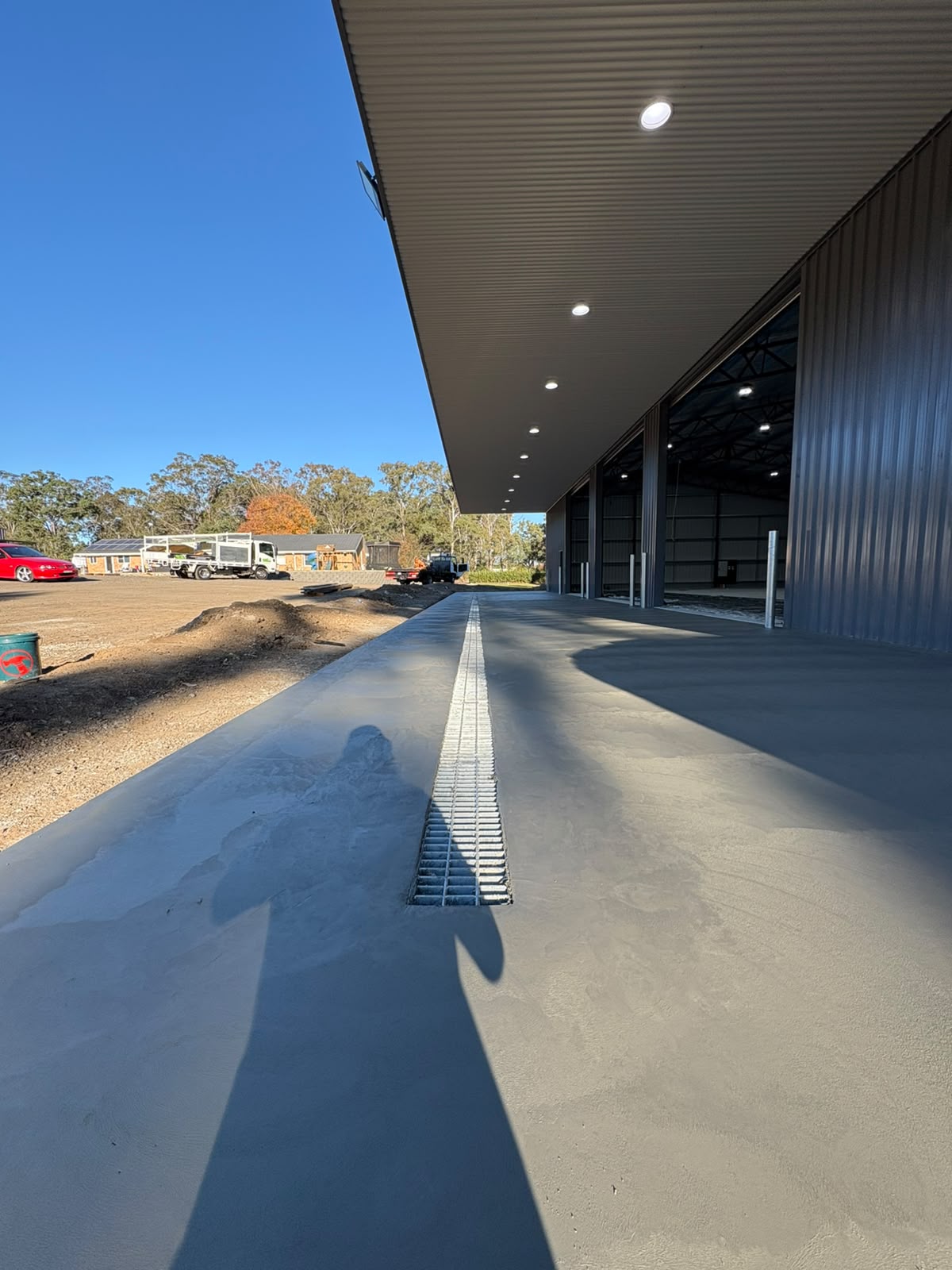
Fall set away from the house across the whole area, with strip drains where the levels alone cannot carry the water away.
Forms set to the shape, including curves, steps and the transition to lawn, garden or pool area.
Mesh on chairs at cover, poured continuously wherever the layout allows so there are no cold joints through a surface this visible.
Finished to the chosen texture, control joints cut on a planned layout, and sealed where the finish calls for it.
Types
Most of this work goes in as part of a larger outdoor project rather than on its own, and it is cheaper and better that way.
The covered or partly covered area off the back of the house. Usually the highest-finish concrete on a property because it is seen up close, every day, in good light.
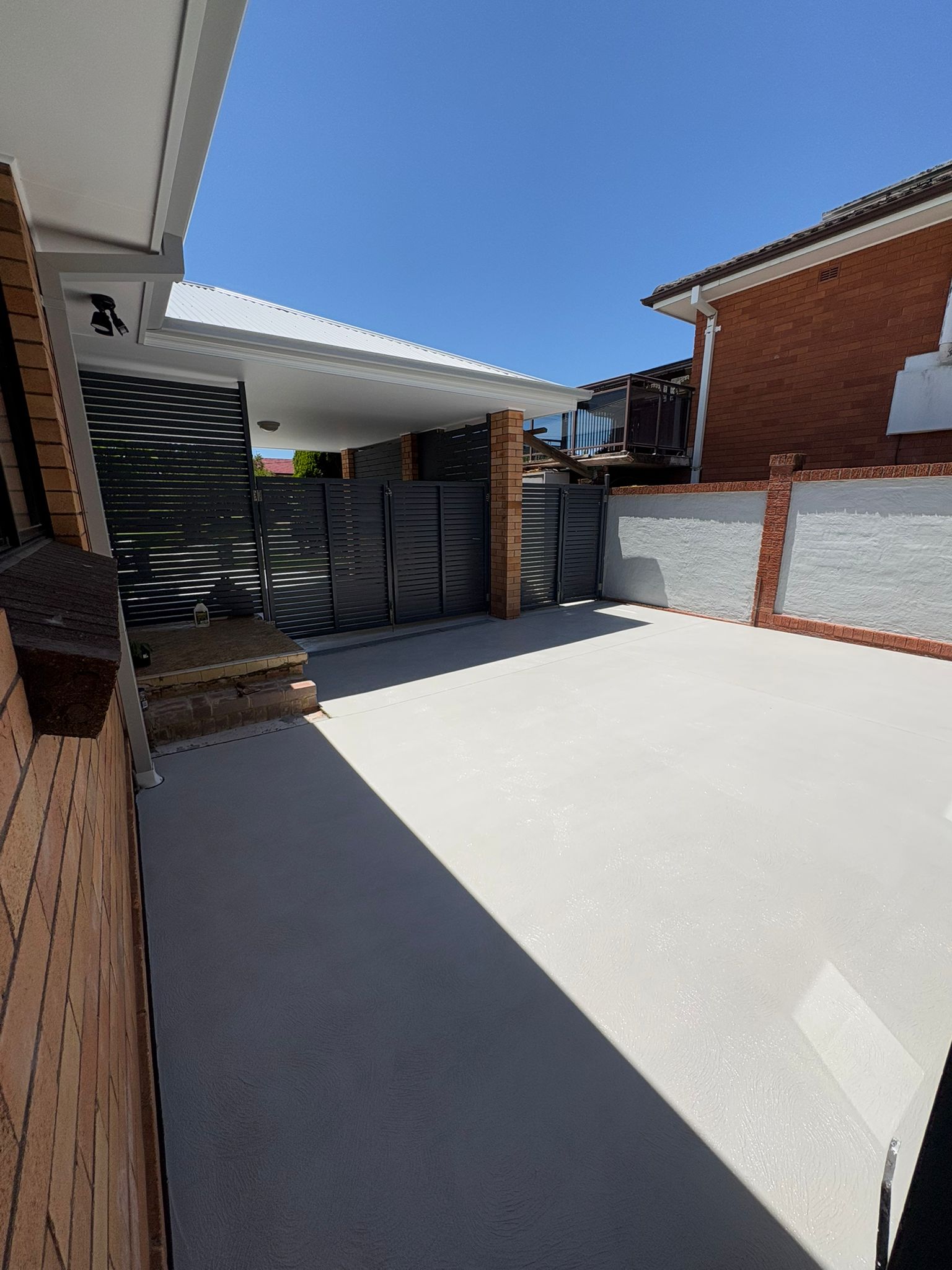
Enclosed and side courtyards, often on awkward access where the pour has to be barrowed or pumped through the house side.

Slabs and bases for outdoor kitchens and BBQ builds, with the service penetrations for gas, water and power set before the pour.

Freestanding entertaining areas away from the house, common on acreage where the best spot is not attached to the building.

Poured continuously with the pool surround so levels, colour and joints carry across — see pool surrounds.

Slabs poured for a patio roof, pergola or outdoor room, including footings and post fixings set in the pour.
Get these right
Entertaining areas go wrong in a handful of predictable ways, and every one of them is decided before the concrete truck arrives.
An outdoor slab poured too high bridges the damp course and puts water into your wall. It is the most expensive mistake on this list and the hardest to undo.
Water has to move away from the house across the entire area. A dead-flat alfresco holds water against the wall every time it rains.
Brickwork weep holes have to stay open. Concreting over them blocks the cavity’s drainage and creates a damp problem inside.
Gas, water, power and drainage for an outdoor kitchen set in place beforehand. Cutting them in afterwards means breaking out the surface you just paid for.
If a pergola or patio roof is coming, the fixings go in at the pour. Drilling into a finished slab later is both weaker and visible.
Dark surfaces get hot. An area meant for bare feet in summer should be chosen with that in mind rather than from a photo.
Pricing
Smaller area than a driveway, but more finishing work per square metre, more edge detail and usually harder access.
Recent work



Why Southo
Damp course, weep holes and thresholds looked at before anything is formed. It is the mistake that costs the most to fix.
This is the concrete you look at every day. Edges, surface consistency and joint layout are where our residential reputation comes from.
Alfresco, pool surround, paths and driveway in one program, so colour and levels actually match.
Pumping and barrowing into tight backyards is routine. It changes the price, not whether we take the job.
Gas, water, power and post fixings in place before the pour rather than cut in afterwards.
Licensed NSW concreting contractor with public liability and home warranty insurance. Details supplied on request.
Send us a photo of the area and rough measurements and we’ll come and look at the levels.
Reviews
Service area
Based in the Hawkesbury, working across the Hills, Sydney and the Central Coast.
Questions
Pavers still need a base, and a poor base is what makes them lift and rock. A single poured surface has no joints to weed, nothing to move independently, and a wider range of finishes. If you want the paver look, stencilled concrete gets close in one continuous pour.
Right up to it, provided the finished level sits below the damp course and keeps the weep holes clear. That constraint often means cutting down rather than building up, which is worth knowing before you plan the levels.
Usually. Limited headroom makes the pour and the finishing harder, and it may need to be barrowed rather than chuted, but it is common work.
For an area used barefoot, lighter colours and a texture that does not get slippery. Honed looks superb up close and suits covered areas best. We will talk through what suits the spot rather than what photographs well.
Closely in most cases, not exactly. Batches vary and concrete weathers. If matching matters, pouring both together is the only way to get it right.
We pour the slab and set the footings and fixings for it. The structure itself is a carpenter or builder’s trade and we coordinate with whoever you use.
Foot traffic within a few days usually, longer for furniture and full use, and sealed finishes need extra time. We give you the dates on the day we pour.


