Gravel to concrete
The most common acreage job. Replacing a gravel or dirt driveway that washes out every storm and needs regrading every year with something that stops costing money.
Acreage & rural driveways
A long acreage driveway has to handle trucks, rain and slope, often all three. We clear, cut and prepare the base ourselves, then form and pour, so one crew builds it from the road to your door.

Length changes everything. A 200 metre driveway has to shed water along its whole run, cross natural drainage lines, carry delivery and service vehicles, and be built over ground that was never engineered. Most of the work happens before the concrete arrives — clearing, cutting, drainage and base over distance.
The complete package
This is the job most concreters decline, and it is the job we are built for. Almost nobody quoting a long rural driveway can do the earthworks that have to happen first.
We walk the whole length. Fall, natural drainage lines, soft ground, rock, tree cover, where the water currently goes and where it will go once the surface is sealed.
Vegetation, stumps and overhanging branches removed along the corridor, including the vertical clearance that service and emergency vehicles need.
The alignment cut and filled to a consistent grade, with crossfall set so water sheds sideways rather than running down the driveway and taking it with it.
Culverts, pipes and cut-off drains where the driveway crosses a natural watercourse or drainage line. Over a long run this is the single most important element.
Road base laid and compacted in layers along the whole run. On long driveways the base is the majority of both the work and the cost.
Formed, reinforced and poured in planned sections with joints where they belong, so a 200 metre slab behaves like a road rather than one enormous piece of concrete.
Types
Very few of these jobs are a straight run of concrete on flat ground. Most involve earthworks, water and access problems before anything is poured.
The most common acreage job. Replacing a gravel or dirt driveway that washes out every storm and needs regrading every year with something that stops costing money.
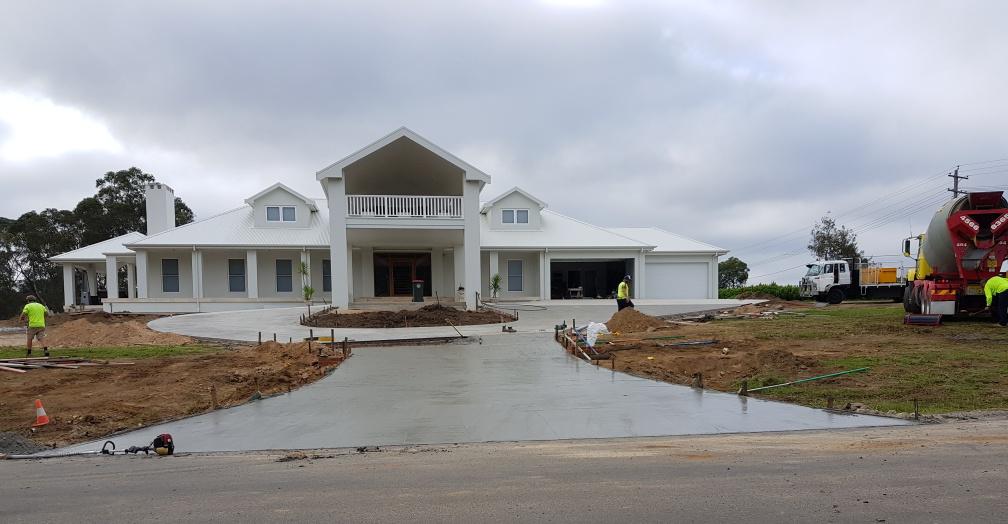
Full driveway from the road frontage to the house, usually built alongside a new build and often needed before other trades can get in reliably.

Access and hardstand to sheds and work areas, built to carry tractors, trucks and floats rather than just cars. Often poured with the slab — see shed slabs.

Driveways on real gradients, where surface texture, crossfall and drainage all have to work together and retaining is often needed alongside.

Turning circles, passing areas and parking hardstand, so delivery trucks and emergency vehicles are not reversing 200 metres down a single lane.

Where a driveway crosses a creek line, gully or drainage easement, the crossing has to be built before the driveway can be. We do both.
Get these right
A suburban driveway fails from a bad base. A rural driveway fails from water, and it fails at the same five places every time.
A flat-topped driveway holds water on the surface. Over 200 metres that water finds the edge, gets under the slab and undermines it from the side in.
Sealing a long driveway turns a strip of absorbent ground into a channel. If there is no table drain or cut-off drain, that volume ends up somewhere it was not going before.
A culvert that handles ordinary rain and not a storm gets overtopped, and the driveway becomes the watercourse. In the Hawkesbury this is not hypothetical.
Base depth is easy to shortcut on a long run because nobody can see it. It is also where most of the cost is, which is why it is the first thing a cheap quote reduces.
A long pour needs a planned joint layout. Without one it cracks where it likes, usually at the point of greatest movement.
Concrete trucks, machinery floats, feed deliveries and fire appliances all use a rural driveway. Designing for a family car is designing for the lightest thing that will ever drive on it.
Pricing
These are quoted after walking the run, always. Nobody can price a long rural driveway from a satellite image without either padding it heavily or raising a variation later.
Before you build
Two things worth checking on a long driveway that never come up on a suburban one.
Planning for Bush Fire Protection is the NSW Rural Fire Service’s principal statutory instrument for development on bush fire prone land, and it covers property access roads directly.
The RFS states the intent plainly: emergency service vehicles need to be able to reach your property at the same time you might be leaving it. The access provisions deal with carriageway width, passing bays, turning areas, vertical clearance, maximum grades, and whether bridges and culverts can carry the weight of a fire appliance.
Much of the Hawkesbury and the Blue Mountains ridge is bush fire prone land, so on a new dwelling or subdivision these requirements can set the width, grade and turning provision of your driveway before you have any say in it. The RFS is currently reviewing the document and expects to finalise an updated version in December 2026.
We build to whatever your bush fire report or consent conditions specify. Confirm the requirements with the RFS, your council or your bush fire consultant before designing the run.
Sources: NSW Rural Fire Service, Planning for Bush Fire Protection 2019 and PBP review information; Rural Fires Act 1997. Checked 15 September 2026.
The point where a driveway joins a public road is a vehicular crossing, and it is generally the council’s to approve rather than yours to build. Both Hawkesbury City Council and The Hills Shire Council operate an application process for vehicle crossings, with their own construction requirements.
On rural roads this often involves a culvert under the crossing so the table drain along the road can keep running. Getting that wrong blocks the road drainage, which is a problem the council will come back to you about.
Everything from the property boundary inward is yours. We build to the council’s crossing specification and coordinate the two so they meet correctly. Confirm the application requirements with your council before work starts.
Sources: Hawkesbury City Council and The Hills Shire Council vehicular crossing application requirements. Checked 15 September 2026.
Recent work


Why Southo
Clearing, cutting, drainage and base under one contractor. This is why we can quote these jobs at all.
Crossfall, table drains and crossings designed for the whole length, not solved section by section.
Long blocks, soft ground, no hardstand, steep approaches. Standard conditions for us rather than reasons to decline.
Trucks, floats, machinery and fire appliances, not just the family car.
Nobody to point at if the driveway settles, because the same crew built the ground and the concrete.
Licensed NSW concreting contractor with public liability and home warranty insurance. Details supplied on request.
Tell us the rough length and where the water sits and we’ll come and walk it with you.
Reviews
Service area
Based in the Hawkesbury, working across the Hills, Sydney and the Central Coast.
Questions
It is quoted per job, not per metre, because on a long run the earthworks and drainage usually cost more than the concrete. Two driveways of identical length on neighbouring properties can differ substantially. We walk the run before quoting.
Yes, and it is our most common acreage driveway job. The existing formation is usually a reasonable starting point but almost never adequate on its own — it still needs regrading, drainage and a proper base.
For the driveway itself on your own land, generally not, though earthworks limits still apply. The crossing where it meets the public road is a different matter and normally needs a council application. Confirm with your council before starting.
On bush fire prone land, the RFS access provisions in Planning for Bush Fire Protection can dictate width, grade, turning areas and culvert load capacity. If your project has a bush fire report or consent conditions, we build to them.
Yes, and a lot of long driveways are staged — the section nearest the house first, the run out to the road later. We set the levels and drainage for the whole length up front so the stages join properly.
We build culverts and crossings as part of the driveway. Where the crossing is significant or the watercourse is mapped, it may need engineering or approval, and we will tell you that at the quote.
Weeks rather than days on most acreage jobs, and weather dependent, because the earthworks stage cannot be rushed. We give you a realistic program at the quote.
Yes. Turning areas, passing bays and hardstand are poured as part of the same job, which is both cheaper and better than adding them later.

Accuracy note
Planning and engineering information on this page is general and was correct at the date checked against the sources named above. Rules change and every site is different — confirm your own situation with Hawkesbury City Council, The Hills Shire Council or a registered certifier. Spotted something out of date? Email southoconcrete2@outlook.com.