
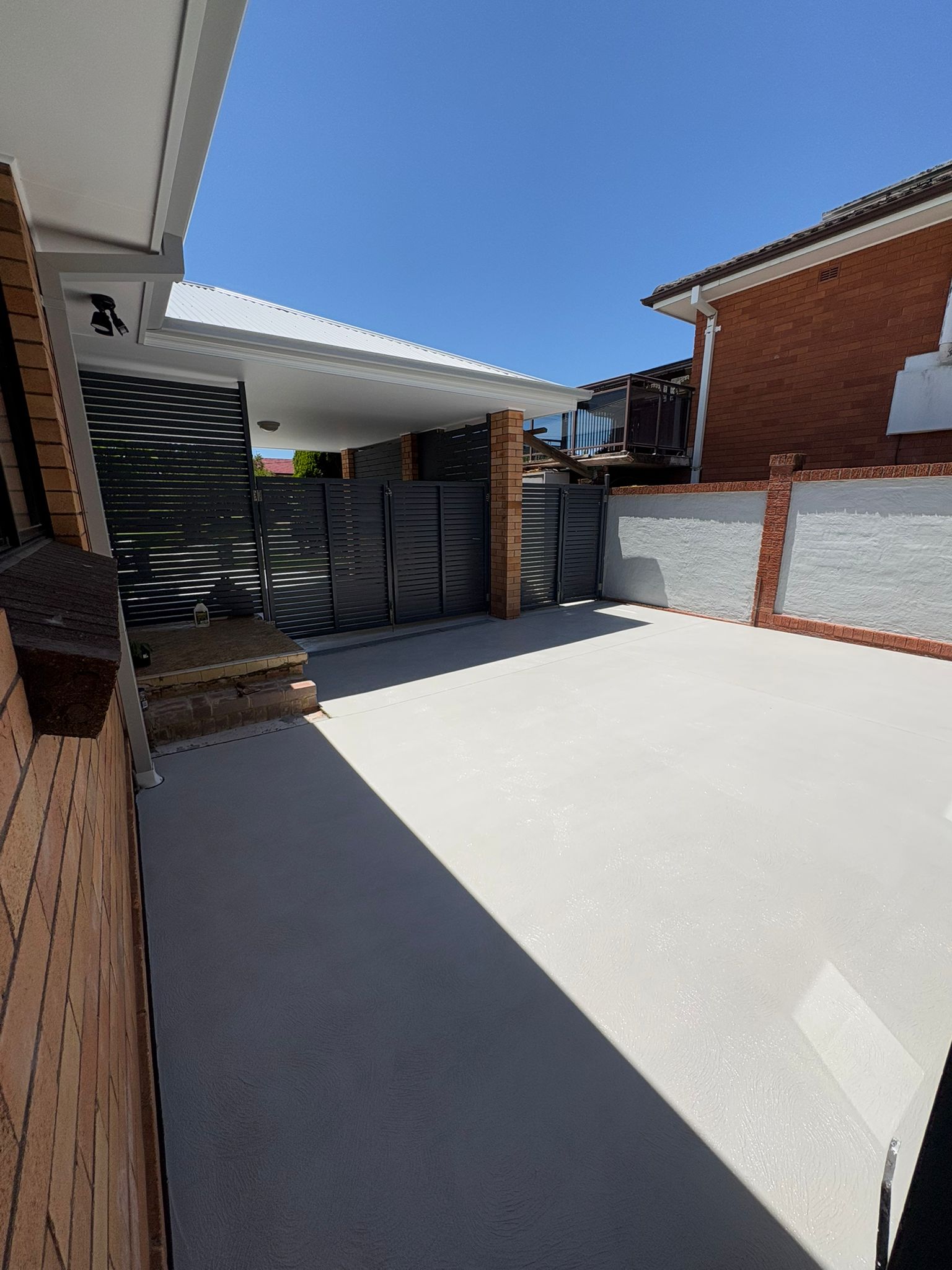
Exposed aggregate
The default choice around water. Washing back the surface exposes the stone, giving texture underfoot and hiding marks and wear. A wide range of stone colours available.
Pool surrounds
The concrete around a pool is what people stand on and walk barefoot across all summer. We set the levels so water runs away from the pool, and finish it to stay comfortable underfoot for years.

Exposed aggregate is the most common choice here, because the exposed stone gives grip when wet and hides marks. Honed and lightly textured finishes look sharper but need the right surface treatment. Whatever the finish, the two things that matter more are the fall away from the water and the surface temperature underfoot.
The complete package
A pool surround is the most visible concrete on most properties and the most technically fussy. It has to drain, it has to be safe wet, and it has to look good from every angle around the water.
We set out against the pool shell, work out the finished surface level, and check what that level does to your pool barrier before anything is formed.
Boxed out, stripped back to firm ground and a compacted base laid. Ground around a new pool is almost always disturbed fill and has to be treated as such.
Surface falls set away from the water, with strip drains or grated drains where the levels cannot shed water on their own.
Forms set to the pool line, including curves and radius work. This is where a surround is won or lost visually — a wobbly edge follows the pool forever.
Mesh placed on chairs at cover, then poured in a single continuous operation wherever the layout allows, so there are no cold joints in a visible surface.
Finished to the chosen texture, control joints cut on a planned layout rather than wherever is convenient, then sealed if the finish calls for it.
Finishes
The finish decides how the area looks, how hot it gets and how it behaves when someone climbs out of the water onto it.
The default choice around water. Washing back the surface exposes the stone, giving texture underfoot and hiding marks and wear. A wide range of stone colours available.
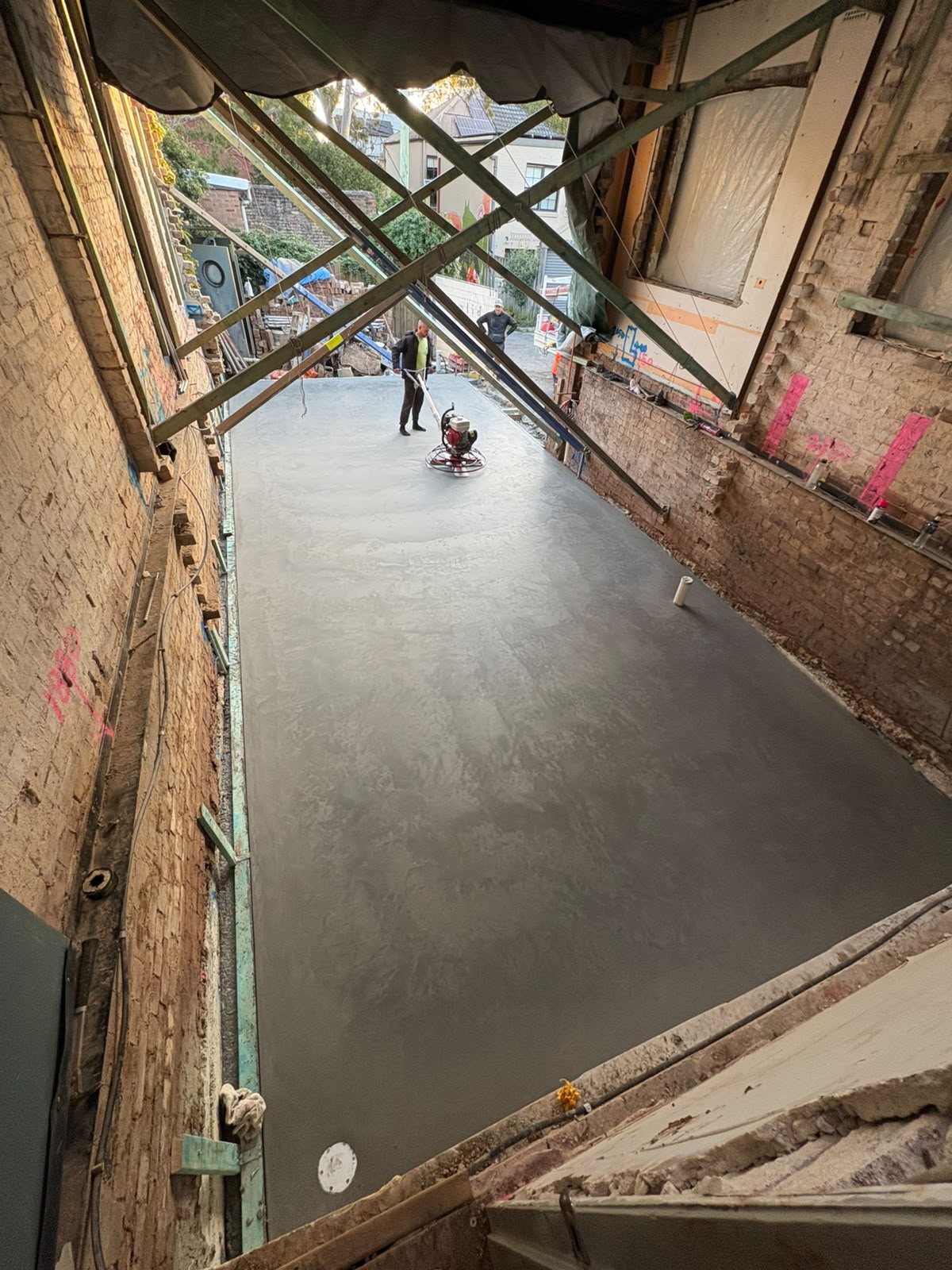
Ground back to a smooth, stone-flecked surface. The sharpest looking option, and the one that most needs an appropriate surface treatment for wet-area grip.

Oxide through the mix for a consistent colour. Worth noting that darker colours hold considerably more heat underfoot in summer.

Pattern and texture applied at the finishing stage. More grip than a smooth surface and a wider range of looks.

The transition from surround to water, including bullnose and square edge details, handled in coordination with your pool builder.

Poured as one continuous area with the adjoining alfresco, paths and steps so levels, colour and joints line up. See decorative concrete.
Get these right
Pool surrounds fail in predictable ways. All four of these are decided before the concrete arrives, and none of them can be fixed afterwards without breaking something out.
Surface has to fall away from the water, not toward it. Get this wrong and every hose-down, every storm and every bit of garden runoff ends up in the filtration system.
Barrier height is measured from finished ground level. Raise the surround and you can shorten a compliant fence into a non-compliant one without touching the fence.
Colour and finish change surface temperature substantially. A charcoal honed surround looks superb in a photo and is unusable barefoot on a February afternoon.
Control joints have to go somewhere. Planned, they read as part of the design. Unplanned, they cut across the middle of the most visible surface on the property.
Pricing
Surrounds price differently to a driveway of the same area, because there is more edge, more detail and more finishing work per square metre.
Compliance
This is the part of a pool surround that catches people out, and the part that costs the most to fix afterwards.
In NSW, pool barriers are governed by the Swimming Pools Act 1992, the Swimming Pools Regulation 2018 and AS 1926.1. A pool fence must be at least 1.2 metres high measured from the finished ground level, and the gap at the bottom must be no more than 100mm from finished ground level.
That means the level you pour to is the level the fence is measured from. Raising a surround by 100mm can turn a compliant fence into a non-compliant one, and dropping levels can open a gap underneath it.
NSW Government guidance also notes that where a pool barrier is modified or altered — which can include yard renovations — the current standard applies from that point and previous exemptions cease. We check the levels against the existing barrier before we form anything.
Sources: NSW Government, owner obligations for pools and spas; Swimming Pools Act 1992; Swimming Pools Regulation 2018; AS 1926.1. Checked 15 September 2026.
AS 1926.1 requires a non-climbable zone around a pool barrier — a 900mm arc on the outside of the fence that must stay clear of anything a child could climb.
Concrete work can encroach on it. A raised surround, a seat, a step or a retaining wall built near the fence line can all put a climbable surface inside the zone and fail an inspection that the fence itself would pass.
Councils in NSW inspect pools on a rolling cycle, and private certifiers can be engaged at any time. We are concreters, not pool certifiers — if your project affects the barrier, get it checked before we pour rather than after.
Sources: AS 1926.1 Swimming pool safety — safety barriers for swimming pools; NSW Government pool owner obligations. Checked 15 September 2026.
Recent work


Why Southo
We look at your barrier before we set a single form. It is the cheapest ten minutes on the job.
Set properly so runoff leaves the area instead of loading your filtration.
Control joint layout worked out with the design, so the cuts sit where they belong.
This is the most looked-at concrete on a property. Edges, curves and surface consistency are where our residential reputation comes from.
Surround, alfresco, paths and steps poured together so colour, level and texture actually match.
Licensed NSW concreting contractor with public liability and home warranty insurance. Details supplied on request.
Send us the pool dimensions and a photo of the area and we’ll come and look at the levels.
Reviews
Service area
Based in the Hawkesbury, working across the Hills, Sydney and the Central Coast.
Questions
Textured finishes give more grip than smooth ones — exposed aggregate is the common choice around water for exactly this reason. Honed and polished surfaces look sharper but need an appropriate surface treatment. We will talk through the trade-off between look and grip rather than just selling the photogenic option.
Noticeably, yes. Darker oxides absorb more heat and a charcoal surround can be uncomfortable barefoot in summer. Lighter aggregates and colours stay cooler. Worth deciding with that in mind rather than from a photo taken in April.
Yes, and a lot of our surround work is exactly that — replacing pavers or old concrete around a pool that has been there for years. We work to the existing coping and check what the new levels do to the barrier.
It can. Barrier height and ground gaps are measured from finished ground level, and the non-climbable zone can be affected by raised concrete near the fence. We check before forming, but final compliance is a matter for your council or a registered pool certifier.
Falls are set away from the pool, with strip or grated drains where the levels cannot shed water on their own. On flat sites this is planned at the quote stage.
Yes, and it is the better way to do it. Pouring the surround and the entertaining area together means one colour batch, matched levels and joints that line up across the whole space.
Foot traffic is usually fine within a few days, but full cure takes longer and sealed finishes need time before heavy use. We give you the dates on the day we pour.


Accuracy note
Planning and engineering information on this page is general and was correct at the date checked against the sources named above. Rules change and every site is different — confirm your own situation with Hawkesbury City Council, The Hills Shire Council or a registered certifier. Spotted something out of date? Email southoconcrete2@outlook.com.


